- Sleep: a state of consciousness. We are less aware of our surroundings.
- Conscious, subconscious, unconscious
- Biological Rhythms
- Annual Cycles: seasonal variations (bears hibernation, seasonal affective disorder)
- 28 day cycles: menstrual cycle
- 24 hour cycle: our circadian rhythm
- 90 minute cycle: sleep cycle
- Circadian Rhythm: our 24 hour biological clock. Our body temperature and awareness changes throughout the day.
- Sleep Stages: there are 5 identified stages of sleep. It takes about 90-100 minutes to pass through the 5 stages. The brain's waves will change according to the sleep stage you are in. The first four stages are known as NREM sleep. The fifth stage is called REM sleep.
- Stage 1: kind of awake and kind of asleep. Only lasts a few minutes, and you usually only experience it once a night. Your brain produces Theta waves (high amplitude, low frequency (slow))
- Stage 2: "baseline" of sleep. Part of the 90 minute cycle and occupies approximately 45-60% of sleep. More Theta waves that get progressively slower. Show sleep spindles... short bursts of rapid brain waves.
- Stage 3 & 4: slow wave sleep. Produce Delta waves. If awoken you will be very groggy. Vital for restoring body's growth hormones and good overall health. May last 15-30 minutes. "Slow wave" sleep because brain activity slows down dramatically from the "theta" rhythm of Stage 2 to a much slower rhythm called "delta" and the height. Delta sleep is the "deepest" stage of sleep and the most restorative. Brain craves delta sleep first and foremost.
- REM Sleep: Rapid Eye Movement. Brain is very active. Dram usually occur in REM. Body is essentially paralyzed.
- Stage 5: composes 20-25% of a normal night sleep. Breathing, heart rate and brain wave activity quicken. Vivid dreams can occur. From REM, you go back to Stage 2.
- Sleep Disorders
- Insomnia: recurring problems in falling or staying asleep.
- Narcolepsy: characterized by uncontrollable sleep attacks. Lapses directly into REM sleep (usually during times of stress or joy).
- Sleep Apnea: a sleep disorder characterized by temporary cessations of breathing during sleep and consequent momentary reawakening.
- Night Terrors: a sleep disorder characterized by high arousal and an appearance of being terrified. Occur in Stage 4, not REM, and are not often remembered.
- Sleepwalking (Somnambulism): sleep walking most often occurs during deep non-REM sleep (stage 3 or 4 sleep) early in the night.
- Dreams: a sequence of images, emotions, and thoughts passing through a sleeping person's mind.
- Manifest Content: the remembered storyline of a dream.
- Latent Content: the underlying meaning of a dream.
- Why do we Dream? Three Theories
- Freud's Wish-Fulfilling Theory: dreams are the key to understanding our inner conflicts. Ideas and thoughts that are hidden in our unconsciousness.
- Information-Processing Theory: dreams act to sort out and understand the memories that you experience.
- Physiological Function Theories
Activation-Synthesis Theory: during the night our brainstem releases random neural activity, dreams may be a way to make sense of that activity.
Friday, May 15, 2015
States of Consciousness

Learning
- Associative Learning: learning that certain events occur together. Initial stage of learning.
- Main Types of Learning:
- Classical Conditioning: it all started with Ivan Pavlov
- Operant Conditioning
- Observational learning
- Latent learning
- Abstract learning
- Insight learning
- Unconditioned Stimulus (UCS): a stimulus that naturally and automatically triggers a response.
- Unconditioned Response (UCR): the unlearned, naturally occurring response to the UCS.
- Conditioned Stimulus (CS): an originally irrelevant stimulus that, after association with the UCS, comes to trigger a response.
- Conditioned Response (CR): the learned response to a previously neutral stimulus.
- Classical Conditioning
- Acquisition: the phase where the neutral stimulus is associated with the USC so that the neutral stimulus comes to elicit the CR (thus becoming the CS).
- Extinction: the diminishing of a CR. Will eventually happen when the UCS does not follow the CS.
- Spontaneous Recovery: the reappearance. After a rest period, of an extinguished conditioned response.
- Generalization: the tendency, once a response has been conditioned, for stimuli similar to the CS to elicit similar responses.
- Discrimination: the learning ability to distinguish between a CS and other stimuli that does not signal UCS.
- Operant Conditioning: a type of learning which behavior is strengthened if followed by reinforcement or diminished if followed by punishment.
- Classical v. Operant
- They both use acquisition, discrimination, SR, generalization, and extinction.
- Classical Conditioning is automatic. Dogs automatically salivate over near, then bell-no thinking involve.
- Operant Conditioning involves behavior where one can influence their environment with behaviors which has consequences.
- Edward Thorndike
- Law of Effect: rewarded behavior is likely to recur.
- Shaping: a procedure in Operant Conditioning in which reinforcers guide behavior closer and closer towards a goal.
- Reinforcer: any event that STRENGTHENS the behavior it follows. Positive and Negative.
- Positive: Strengthens a response by presenting a stimulus after a response.
- Negative: Strengthens a response by reducing or removing an aversive stimulus.
- Primary Reinforcer: an innately reinforcing stimulus.
- Conditioned (Secondary) Reinforcer: a stimulus that gains it reinforcing power through its association with a primary reinforcer.
- Continuous Reinforcement: reinforcing the desired response ever time it occurs.
- Partial Reinforcement: reinforcing a response only part of the time. The acquisition process is slower. Greater resistance to extinction.
- Fixed-ratio Schedule: a schedule that reinforces a response only after a specified number of responses.
- Variable-ratio Schedule: a schedule of reinforcement that reinforces a response after an unpredictable number of responses.
- Fixed-interval Schedule: a schedule of reinforcement that reinforces a response only after a specific time has elapsed.
- Variable-interval Schedule: a schedule of reinforcement that reinforces a response at unpredictable time intervals.
- Punishment: meant to decrease a behavior
- Positive: addition of something unpleasant.
- Negative: removal of something pleasant.
- Token Economy: every time a desired behavior is performed, a token is given.
- Observational Learning: we learn through modeling behavior from others.
Observational Learning + Operant Conditioning = Social Learning Theory - Latent Learning: sometimes learning is not immediately evident.
- Insight Learning: some animals lear through the "ah ha" experience.
Memory
The persistence of learning over time through the storage and retrival of information.
- The Memory Process
- Encoding: the processing information into the memory system.
- Storage: the retention of encoded material over time.
- Retrieval: the process of getting the information out of memory storage.
- Recall vs. Recognition
- Recall: retrieve information from your memory.
- Recognition: identify the target from possible target.
- Flashbulb Memory: a clear moment of an emotionally significant moment of event.
- Types of Memory
- Sensory Memory: the incited requiring of sensory information in the memory system. Stored just for an instant and gets process the last half of second of visual. It last 2-4 seconds of auditory then the capacity of story is large and if energy is transferred, information is lost.
- Short-term Memory: memory that holds a few items briefly seven digits (plus or minus two).
Working Memory: audio and visual both control where your attention lies. - Long-term Memory: a permanent and limitless storage house.
Encoding: getting information in our information.

- Two Ways to Encode Information
- Automatic Processing: unconscious encoding of incidental information.
- Effortful Processing: encoding that requires attention and conscious effort.
- Things to remember about Encoding:
- The Next-in-Line Effect: we seldom remember what there person has just said or sone if we are nest.
- Information minutes before sleep is seldom remembered; in the hour before sleep; well-remembered.
- Taped if played while asleep is registered by ears, but we do not remember it.
- Spacing Effect: we encode better when we study or practice over time.
- Serial Positioning Effect: our tendency to recall best the last and first items in a list.
- Types of Encoding:
- Semantic Encoding: the encoding of meaning, like the meaning of words.
- Acoustic Encoding: the enforcing of sound, especially the sounds of words.
- Visual Encoding: the encoding of picture images.
- Self-Referent Effect: the idea that we remember things (like adjectives) when they are used to describe ourselves.
- Tricks to Encode
- Imagery: mental pictures
- Chunking: organizing items into familiar, manageable units. Often it will occur automatically.
Storage
- Iconic Memory: a mementary sensory memory of visual stimuli, a photograph like quality lasting only about a second. We also have an echoic memory for auditory stimuli.
- Storing Memories
Long Term-Potentiation: long-lasting enhancement in signal transmission between two neurons that results from stimulating them synchronously. - The Hippocampus: damage to the hippocampus disrupts our memory.
Left=Verbal
Right=Visual and Location - Types of Retrieval Failure
- Proactive Interference: the disruptive effect of prior learning on the recall of new information.
- Retroactive Interference: the disruptive effect of new learning on the recall of old information.
Intelligence
The ability to learn from experience, solve problems, and use knowledge to adapt to new situations.
- Factor Analysis: a statistical procedure that identifies clusters or related items on a test.
- Charles Spearman used FA to discover his g or (general intelligence).
- Multiple Intelligence: Howard Gardner disagree with Spearman's g and came up with the concept of multiple intelligence. He came up with the idea by studying savants(a condition where a person has limited mental ability but is exceptional in one area).
- Gardner's Multiple Intelligence:
- Visual/Spatial
- Verbal/Linguistic
- Logical/Mathematical
- Bodily/Kinesthetic
- Musical/Rhythmic
- Interpersonal
- Intrapersonal
- Natural
- Sternberg's Three Aspects of Intelligence:
- Analytical (academic problem solving)
- Creative (generating novel ideas)
- Practical (required for everyday tasks where multiple solutions exist)
- Emotional Intelligence: the ability to perceive, express, understand and regulate emotions.
- Brain Function and Intelligence: higher performing brains use less active that lower performing brains (use less glucose). Neurological speed is also a bit quicker.
- Mental Age: what a person of a particular age should know.
- Problems with the IQ formula: it doesn't work well with adults.
- Modern Tests of Mental Abilities: Wechsler Adult Intelligence Scale(WAIS) consists of 11 subjects and cues us in strengths by using factor analysis.
- Aptitude v. Achievement Tests
- Aptitude: a test designed to predict a person's future performance. The ability for that person to learn.
- Achievement: a test designed to assess what a person has learned.
- Standardization: the test must be pre-tested to a representative sample of people.
- Flynn Effect: intelligence test performance has been rising.
- Reliability: the extent which a test yields consistent results over time.
- Validity: the extent to which a test measures what is suppose to be measure.
- Content Validity: does the test sample a behavior of interest.
- Predictive Validity: does the test predict future behavior.
- Does Intelligence Change Over Time?
By age 3, a child's IQ can predict adolescent IQ scores. Depends on the type of intelligence, crystallized of fluid.
Unit 6
Language: our spoken, written or gestured words and the way we combine them to communicate.
- Phonemes: in a spoken language, the smallest distinctive sound unit.
- Morphemes: in a language, the smallest unit that carries meaning. Can be a word or part of a word(prefix or suffix).
- Grammar: system of rules in a language that enables us to communicate and understand others.
- Semantics: the set of rules by which we derive meaning in a language. Adding -ed at the end of words meaning past tense.
- Syntax: the rules for combining words into grammatically sensible sentence.
- Language Development
- Balling Stage (3-4 months): the infant make spontaneous sounds.
- One-word Stage (1-2 years): uses one word to communicate big meanings.
- Two-word Stage (2 years): uses two words to communicate meanings-called telegraphic speech.
- Skinner: though that we can explain language development through social learning theory.
- Psychologist
- Chomsky: we acquire language too quickly for it to be learned. We have this "learning box" inside our heads that enable us to learn any human language.
- Whorf's Linguistic Relativity: the idea that language determines the way we think.
Thinking
- Cognition: another term for thinking, knowing, and remembering.
- Concepts: a mental grouping of similar objects, events, dead, or people.
- Prototypes: a mental image or best example of a category.
- Algorithms: a methodical, logical rule or procedure that guarantees solving a particular problem.
- Heuristics: a rule-of-thumb strategy that often allows us to make judgements and sole problems efficiently.
- Insight: a sudden and often novel realization of the solution to a problem.
- Confirmation Bias: a tendency to search for information that confirms one's preconceptions.
- Match Problem
- Fixation: the inability to see a problem from a new perspective.
- Mental Set: a tendency to approach a problem in a particular way, especially if it has worked in the past.
- Functional Fixedness: the tendency to think of things only in terms of their usual functions.
Types of Heuristics (That often lead to errors)
- Representativeness Heuristic: a rule of thumb for judging the likelihood of things in terms of how well they match our prototype.
- Availability Heuristic: estimating the likelihood of events based on their availability in our memory.
- Overconfidence: the tendency to be more confident that correct.
- Framing: the way an issued is posed.
- Belief Bias: the tendency for one's preexisting beliefs to distort logical reasoning.
- Belief Perseverance: clinging to your initial conceptions after the basis on which they were formed has been discredited.
- Artificial Intelligence
Perception
The process of organizing and interpreting information, enabling us to recognize meaningful objects and events.
- Visual Capture: the tendency for vision to dominate the other senses.
- Gestalt Psychology: Gestalt means "an organized whole." These psychologists emphasize our tendency to integrate pieces of information into meaningful wholes.
- Gestalt Philosophy: the whole is greater than the sum of its parts.
- Figure-Ground Relationship: the organization of the visual field into objects(figures) that stands out from their surroundings(ground).
- Grouping: the perceptual tendency to organize stimuli into groups that we understand.
- Proximity: where we group similar figures together.
- Similarity: we group similar figures together.
- Continuity: we group continuous patterns together.
- Connectedness: we group together uniform and linked figures.
- Depth Perception: the ability to see objects in three dimensions although the images that strike the retina are two dimensional.
- How do we transform 2D objects to 3D perception?
- Binocular Cues: depth cues that depends on two eyes.
- Retinal Disparity: a binocular cue for seeing depth. The closer an object comes to you the greater the disparity in between the two.
- Monocular Cues: depth cues that depends on two eyes.
- Interposition: if someone is blocking our view, we perceive it as closer.
- Relative Size: if we know that two objects are similar in size, the one that looks smaller is farthest away.
- Relative Clarity: we assume hazy objects are farther away.
- Texture Gradient: the coarser it looks the closer it is.
- Relative Height: things higher in our field of vision, they look farther away.
- Relative Motion: things that are closer appear to move more quickly. Linear Perspective: parallel lines seem to converge with distance.
- Light and Shadow: dimmer objects appear farther away because they reflect less light.
- Phi Phenomenon: an illusion of movement created when two or more adjacent lights blink on and off in succession.
- Perceptual Consistency: perceiving objects as unchanging even as illumination and retinal images changes.
Smell, Taste, and Touch
- Tongue
- Papillae: those bums on our tongue. Help grip food while your teeth are chewing. Contain taste buds.
- Sweet is located on the tip of your tongue and it is sensed when our tastebuds come into contact with sugar.
- Salty is sensed when salty sensitive tastebuds come into contact with salt. It is located on the front side of the tongue.
- Sour is sensed when our tastebuds comes into contact with acid. Located on the back side of the tongue.
- Bitter is sensed when our tastebuds come in contact with an alkali metal. Located on the base of the tongue.
- Spicy is sensed when the no receptors in our mouth come into contact with a chemical that irritate it.
- Smell
- Pheromones: chemical messengers that are picked up through our sense of smell.
- Touch: receptors are located in our skin.
- Gate Control Theory of Pain: the nervous system blocks or allows pain signals to pass to the brain.
- Vestibular Sense: tells us where our body is oriented in space. Our sense of balance. Located in our semicircular canals in our ears.
- Kinesthetic Sense: tells us where are body parts are. Receptors located in our muscles and joints.

Vision and Hearing
- Vision
- Wavelength: the distance from the peak of one light wave to the peak of the nest. The distance determines the hue(color) of the light we perceive.
- Intensity: the amount of energy in a light wave. Determined by the height of the wave. The higher the wave the more intense the light is.

- Parallel processing: the processing of several aspects of a problem simultaneously.
- Two Major Color Theory
- Young-Helmholtz Trichromatic(three color) Theory: realized that any color can be created by combining the light waves of three primary color.
Rods facilitate black and white vision.
Cones facilitate color vision. - Opponent-Process Theory: we cannot see certain colors together in combination (red-green, blue-yellow, and white-black). These are antagonist/opponent colors.
- Hearing
- Frequency: the number of complete wavelengths that pass through point of a given time. This determines the pitch of a sound.
- Amplitude: how loud the sound is. The higher the crest of the wave is the louder the sound is. Measured in decibels.

- Helmholtz's Place Theory: we hear different pitches because different sound waves trigger activity at different places along the cochlea's basilar membrane.
- Frequency Theory: we sense pitch by the basilar membrane vibrating at the same rate as the sound.
- Hearing Loss
- Conduction Hearing Loss: caused by damage to mechanical system of ear.
- Sensorineural Hearing Loss: caused by damage to cochlea's receptor cells or to auditory nerves.
Unit 5
Sensation and Perception
- Sensation: your window to the world. The process by which our sensory receptors and nervous system receive stimulus from the environment.
- Perception: interpreting what comes in your window. The process of organizing and interpreting sensory information, enabling us to recognize meaningful objects and events. Perception is essentially an interpretation and elaboration of sensations.
- Bottom-Up vs. Top-Down Processing
- Bottom-Up Processing: analysis that begins with the sense receptors and works up to the brain's integration of sensory information.
- Top-down Processing: information processing guided by higher-level mental processes. As when we construct perceptions drawing on our experience and expectations.
- Absolute Threshold: the minimum stimulation needed to detect a stimulus 50% of the time.
- Difference Threshold: the minimum difference that a person can detect between two stimuli. Also known as Just Noticeable Difference.
- Weber's Law: the idea that, to perceive a difference between two stimuli, they must differ by a constant percentage, not a constant amount.
- Signal Detection Theory: predicts how we detect a stimulus amid other stimuli. Assumes that we do not have an absolute threshold, we detect stuff based on our experiences, motivation and fatigue level.
- Subliminal Stimulation: below one's absolute threshold for conscious awareness.
- Transduction: transforming signals into neural impulses. Information goes from the senses to the thalamus, then to the various areas in the brain.
- Sensory Adaptation: diminished sensitivity as a result of constant stimulation.
- Selective Attention: the focusing of conscious awareness on a particular stimulus.
- Cocktail Part Effect: ability to listen to one voice among many.
Tuesday, April 7, 2015
Parenting Styles
- Authoritarian Parents: they have strict standards for children behavior.
- Permissive Parents: they allow freedom, lax parenting, and don't enforce rules.
- Authoritative Parents: they set reasonable standards and encourage independence.
Stage Theorist
- Sigmund Freud: we all have a libido (sexual drive). Our libido travels to different areas of our body through out our development.
- Oral Stage (0-1): seek pleasure through our mouths. Psychological task: weaning.
- Anal Stage (1-3): libido is focused on controlling waste and expelling waste. Psychological task: toilet training
- Phallic Stage (3-6): children first recognize their gender.
- Latency Stage (6-11): libido is hidden.
- Genital Stage (11 and up): libido is focused on their genitals. Experience sexual feelings toward others.
- Kohlberg's theory of moral development
- Pre-conventional morality (0-6): Morality based on rewards and punishments.
- Conventional morality (7-11): Look at morality based on how others see you.
- Post-conventional morality (12-Up): Based on self-defined ethical principles.
- Criticisms of Kohlberg: Carol Gilligan pointed out that Kohlberg only tested boys. Boys tend to have a more absolute value of morality.
- Erikson's Eight Stages of Psychosocial Development
- Basic Trust vs. Mistrust (0-1): care givers who reliably meet the infant's needs foster a sense of trust in others.
- Autonomy vs. Shame and doubt (1-3): Reasonable limits by caregivers lead to a basic sense of independence in exploring the world.
- Initiative vs. Guilt (3-6): Child has a sense of purpose and is able to initiate play and reach goals without violating the rights of others.
- Industry(Competence) vs. Inferiority (6-12): Child develops a sense of competence and accomplishment.
- Identity vs. Role Confusion (Teens): Individual achieves a stable sense of identity and makes realistic plans for adult life.
- Intimacy vs. Isolation (Young Adult): Individual establishes meaningful and satisfying close relationships.
- Generativity vs. Stagnation (Mid-Adult): Individual attains a sense that he or she is making useful contributions to the world and the future through family and work activities.
- Ego Integrity vs. Despair (Late Adult): Individual looks at like and decides that it has been meaningful and satisfying.
- Adolescence: the transition period from childhood to adulthood.
- Puberty: the period of sexual maturation during which a person becomes capable of reproducing.
- Primary Sexual Characteristics: body structure that make reproduction possible.
- Second Sexual Characteristics: non-reproductive sexual characteristics.
- Landmarks for Puberty: menarche for girls. First ejacuation for boys.
- Adulthood: all physical abilities essentially peak by our mid twenties.
- Physical Milestones: menopause- the natural ending of a woman's ability to reproduce. Men do not experience anything like menopause.
- Types of Intelligence:
- Crystallized Intelligence: accumulated knowledge. Increases with age.
- Fluid Intelligence: ability to solve problems quickly and think abstractly
Developmental Psychology
The study of YOU from womb to tomb.
- Nature Versus Nurture
- Nature: The way you were born.
- Nurture: The way you were raised.
- Physical Development: focus on our physical changes over time.
- Prenatal Development: conception begins with the drop of an egg and the release of about 200 million sperms.
- Once the sperm penetrates the egg- we have a fertilized egg called a zygote.
- The first stage lasts about two weeks.
- About 10 days after conception, the zygote will attach itself to the uterine wall.
- The outer part of the zygote becomes the placenta- structure that allows oxygen and nutrients
- After two weeks, the zygote develops into an embryo.
- Last about 6 weeks. Heart begins to beat and organs start to develop.
- By nine weeks we have a fetus.
- Teratogens: chemical agents that can harm the prenatal environmental.
- Reflexes: inborn automatic responses.
- Rooting (cheek): when a newborn infant is touched on the cheek, the infant will turn its head toward the source of simulation.
- Grasping: if an object is placed into a baby's palm, the baby will try to grasp the object with his or her fingers.
- Moro (startle): when startled, a baby will fling his or her limbs out and then quickly retract them.
- Babinski (foot): when a baby's foot is stroked, he or she will spread their toes.
- Maturation: physical growth processes that enable orderly changes in behavior, regardless of the environment.
- Cognition: all mental activities associated with thinking, knowing, and remembering.
- Cognitive Development- Jean Piaget
- Schemas: ways we interpret the world around us (concept)
- Assimulation: incorporation new experiences into existing schemas.
- Accommodation: changing an existing schema to adapt to new information.
- 4 Stages of Cognitive Development
- Sensorimotor Stage (0-2): experience the work through our senses. Object permanence developed around 6-8 months of age.
- Preoperational Stage (2-7 years): begin to use language to represent objects and ideas. Egocentric: early in this stage they cannot look at the world through anyone's eyes.
- Conservation refers to the idea that a quantity remains the same despite changes in appearance and it part of logical thinking.
- Concrete Operational Stage (7-11 years): can demonstrate concept of conservation. Learn to think logically.
- Formal Operational Stage (12 years and up): abstract reasoning. Hypothesis testing. reasoning with metaphors and analogies.
- Criticisms of Piagets
- Information-Processing Model: says children do not learn in stages but rather in a gradual continuous growth pattern.
- Social Development: at about a year, infants develop stranger anxiety.
- Attachment: attachment (a bond with a caregiver). Konrad Lorenz discovered that some animals form attachment through imprinting.
- Origins of Attachment: Harry Harlow showed that monkeys needed to touch or body contact to form attachment. For many animals that there is a critical period shortly after birth when an organism's exposure to certain stimuli or experiences produce proper development.
- Secure Attachment: children show some distress when parent leaves, seek contact at the reunion, explore when parent gone, play and greet when parent present.
- Stranger Anxiety: fear of strangers, beginning by about 8 months of age.
- Separation Anxiety: distress the infant shows when object of attachment leaves. Peaks between 14 and 18 months.
The Brain
- Accidents: Phineas Gage Story-Personality changed after the accident.
- Lesions: removal or destruction of some part of the brain. Frontal Lobotomy
- Electroencephalogram (EEG): detects brain waves through their electrical output. Used mainly in sleep research.
- Computerized Axial Tomography (CAT Scan): 3D X-Ray of the brain. good for tumor locating but tells us nothing about function.
- Magnetic Resonance Imaging (MRI): more detailed picture of brain using magnetic field to knock electrons off axis.
- Positron Emission Tomography (PET Scan): measures how much of a chemical the brain is using (usually glucose consumption).
- Hindbrain: structures on top of our spinal cord. Controls basic biological structures.
- Pons: located just above the medulla.
- Cerebellum: bottom rear of the brain. "Little brain." coordinates fine muscle movements.
- Midbrain: coordinates simple movement with sensory information. Most important structure in Midbrain is the Reticular Formation: controls arousal and ability to focus our attention.
- Forebrain: what makes us human. Largest part of the brain. Made up of the Thalamus, Limbic System, and Cerebral Cortex.
- Thalamus: receives sensory signals from the spinal cord and sends them to other parts of the forebrain. Every sense except smell.
- Limbic System
- Hypothalamus: maybe most important structure in the brain. Controls and regulates: body temperature, sexual arousal, hunger, thirst, and endocrine system.
- Hippocampus: involved in the processing and storage of memories.
- Amygdala: involved in how we process memory. More involved in volatile emotions like anger.
- Cerebral Cortex: made up of densely packed neurons we call "gray matter." Glial Cells: support brain cells. Wrinkles are called fissures.
- Hemispheres: divided into two hemisphere.
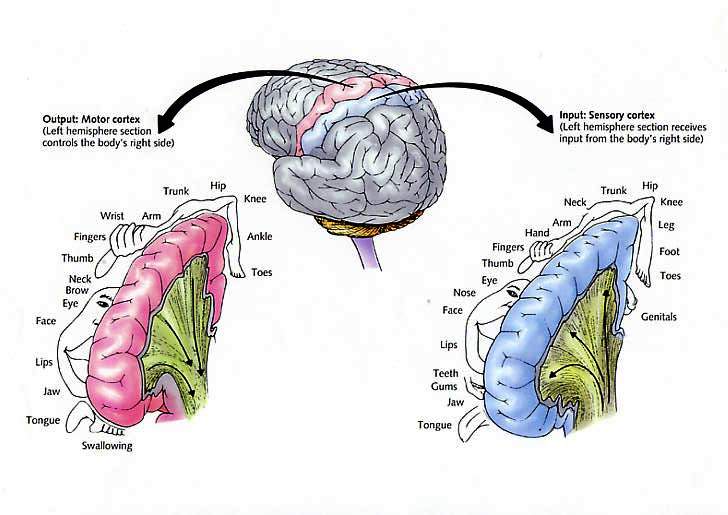
- Contralateral control: right controls left and vice versa.
- Left Hemisphere: logic and sequential tasks.
- Right Hemisphere: spatial and creative tasks.
- Frontal Lobes: abstract thought and emotional control.
- Motor Cortex: sends signals to our body controlling muscle movements.
- Broca's Area: responsible for controlling muscles that produce speech.
- Broca's Aphasia: damage to Broca's Area. Unable to make movements to talk.
- Parietal Lobes: contain Sensory Cortex:
- Sensory Cortex: receives incoming touch sensations from rest of the body. Most of the Parietal Lobes are made up of Association Areas.
- Association Areas: any areas not associated with reviving sensory information or coordinating muscle movements.
- Occipital Lobes: deals with vision. Contains Visual Cortex: interprets messages from our eyes into images we can understand.
- Temporal Lobes: process sound sensed by our ears. Contains Wernike's Area: interprets written and spoken speech. Wernike's Aphasia: unable to understand language: the syntax and grammar jumbled.
- Brain Plasticity: the idea that the brain, when damaged, will attempt to find new ways to reroute messages.
- The Corpus Callosum: bridge of nerve fibers that connects or divides the two hemisphere.
- Cerebrum: largest part of the brain. Divided into left and right hemisphere & divided into lobes. Also contains the cerebral cortex (the gray matter). Controls voluntary movement, coordinates mental activity, and it's the center for all conscious living.


Nervous System
- Central Nervous System: the brain and spinal card.
- Peripheral Nervous System: all nerves that are not encased in bone. Everything but the brain and spinal cord.
- Somatic: controls voluntary muscle movement. Uses motor neurons.
- Autonomic: controls the automatic functions of the body.
- Sympathetic: fight or flight response. Automatically accelerates heart rate, breathing, dilates pupils, slows down digestion.
- Parasympathetic: automatically slows the body down after a stressful event. Heart rate and breathing slow down pupils constrict and digestion speeds up.
- Reflexes: normally, sensory neurons take info up through spine to the brain. Some reactions occur when sensory neurons reach just the spinal cord.
- Hormones
- The Endocrine System: a system of glands that secrete hormones. Similar to nervous system, except hormones work a lot slower than neurotransmitters.
Monday, April 6, 2015
Unit 4
- Nervous System: it starts with an individual nerve cell called a NEURON
- How does a Neuron fire?
- Resting potential: slightly negative charge
- Reach the threshold when enough neurotransmitters reach dendrites.
- Go into Action Potential (firing)
- The All-or-None Response: the idea that either the neuron fires or it does not-no part way firing. Like a gun.
- Steps of Action Potential
- Dendrites receive neurotransmitter from another neuron across the synapse.
- Reached its threshold- then fires based on the all-or-none response.
- Opens up a portal in axon, and lets in positive ions (Sodium) which mix with negative ions (Potassium) that is already inside the axon (thus Neurons at rest have a slightly negative charge).
- The mixing of + and - ions causes an electrical charge that opens up the next portal (letting in more K) while closing the original portal.
- Process continues down axon to the axon terminal.
- Terminal buttons turns electrical charge into chemical (neurotransmitter) and shoots message to next neuron across the synapse.
- Types of Neurotransmitter
- Acetylcholine (ACH): deals with motor movement and memory. Lack of ACH has been linked to Alzheimer's disease.
- Dopamine: deals with motor movements and alertness. Lack of dopamine has been linked to Parkinson's disease. Too much has been linked to schizophrenia.
- Serotonin: involved in mood control. Lack of serotonin has been linked to clinical depression.
- Endorphins: involve in pain control. Many of our most addictive drugs deal with endorphins.
- Norepinephrine: helps control alertness and arousal. An undersupply can lead to depression. An oversupply can lead to manic symptoms
- GABA (gamma-aminobutytic acid): major inhibitory neurotransmitters. An undersupply can lead to tremor.
- Glutamate: major excitatory neurotransmitter; involved in memory. Oversupply can overstimulate the brain leading to migraines (this is why some people avoid MSG in food).
- Drugs can be...
- Agonist- make neuron fire
- Antagonists- stop neural firing
- Reuptake Inhibitors- block neurotransmitters from entering the neuron.
- Types of Neurons
- Sensory Neurons (Afferent Neurons): take information from the senses to the brain.
- Inter Neurons: take messages from Sensory Neurons to other parts of the brain or to Motor Neurons.
- Motor Neurons (Efferent Neurons): take information from the brain to the rest of the body.
Thursday, March 5, 2015
Motivation and Emotion
Motivation: a psychological process that directs and maintains your behavior toward a goal. Motives are the needs, wants, interests, and desires that propel or drive people in certain directions.
- Instinct Theory: we are motivated by our inborn automated behaviors.
- Biological Motives
- Hunger
- Thirst
- Sleep
- Social Motives
- Achievement
- Order
- Play
- Autonomy
- Affiliation
- Drive Theory: Biological internal motivation (homeostasis)
- Incentive Theory: Environmental motivation (not as much homeostasis, more outside factor)
- Drive-Reduction Theory: When individuals experience a need or drive, they're motivated to reduce that need or drive.
Biological Basis of Hunger: Hunger does not come from our stomach. It comes from our brain, they Hypothalamus
- Why do I feel hungry?
- Glucose: the form of sugar that circulates in the blood. Provides the major source of energy for body tissue. Glucose low=hungry, Glucose high=feel full
- Lateral Hypothalamus: when simulated it makes you hungry. When lesioned (destroyed) you will never be hungry again.
- Ventromedial Hypothalamus: when simulated you feel full. When lesioned you will never feel full again.
- Environmental Factors
1. Availability of food
2. Learned preference and habits
3. Stress - Set Point Theory: the hypothalamus acts like a thermostat. Wants to maintain a stable weight. Activate the lateral when you diet and activate the ventromedial when you start to gain weight.
Eating Disorders
- Bulimia Nervosa: characterized by binging (eating large amounts of food) and purging (getting rid of the food).
- Anorexia Nervosa: starve themselves to below 85% of their normal body weight.
- Obesity: severely overweight to the point where it causes health issues.
Achievement Motivation
- Intrinsic Motivators: rewards we get internally, such as enjoyment or satisfaction.
- Extrinsic Motivators: reward that we get for accomplishments from outside ourselves (grades or money or etc.) Work great in the short run.
- Over Justification Effect: promising a reward for doing something you like to do results in you seeking the rewards as the motivation for performing the task.
Management Theory
- Theory X: managers believes that employees will work only if rewarded with benefits or threatened with punishment.
- Theory Y: managers believe that employees are internally motivated to do good work and policies should encourage this internal motive.
Emotion: a response of the whole organism
Physiological arousal
Expressive behaviors
Conscious experience
Physiological arousal
Expressive behaviors
Conscious experience
- James-Lange Theory of Emotion: experience of emotion is awareness of physiological responses to emotion-arousing stimuli.
- Cannon-Bard Theory of Emotion: emotion-arousig stimuli simultaneously trigger:
- physiological responses
- subjective experience of emotion
- Schachter's Two-Factor Theory of Emotion: to experience emotion one must:
- be physically aroused
- cognitively label the arousal
- Emotion-Lie Detectors
- Polygraph: machine commonly used in attempts to detect lies. Measures several of the physiological responses accompanying emotion
- Perspiration
- Cardiovascular
- Breathing changes
- Amygdala: a neural key to fear learning
Experienced Emotion
- Catharsis
- emotional release
- catharsis hypothesis: "releasing" aggressive energy (through action or fantasy) relieves aggressive urges.
- Feel-good, do good phenomenon: people's tendency to be helpful when already in a good mood.
- Adaptation-Level Phenomenon: tendency to form judgements relative to a "neutral" level
- brightness of lights
- volume of sound
- level of income
- Relative Deprivation: perception that one is worse off relative to those with whom one compares oneself.
Social Relations
- Prejudice: an unjustifiable attitude towards a group of people.
- Stereotyped: a generalized belief about a group of people.
- Social Inequalities: a principle reason behind prejudice.
- Ingroup: people with whom one shares a common identity.
- Outgroup: those perceived as different than ones in group.
- Ingroup bias: the tendency to favors one own group.
- Scapegoat Theory: the theory that prejudice provides an outlet for anger by providing someone to blame.
- Aggression: any physical or verbal behavior intended to hurt or destroy.
- Biology of Aggression
- Genetics
- Neural Influence (is aggression in the brain)
- Biochemical
- Frustration-Aggressive Principle: the blocking of an attempt to achieve some goals. Creates anger which generate aggression.
- Conflict: a perceived incompatibility of actions, goals or ideas. Situation where people must choose between and act that is beneficial to themselves but harmful to others and an act that is moderately beneficial to all.
Attraction:
- Proximity: repeated exposure to something breeds liking.
- Reciprocal Liking: you are more likely to like someone who likes you.
- Similarity: Opposites do not attract. Birds of the same feather do flock together. Similarity breeds content.
- Liking through Association
- Physical Attractiveness
- Love
- Passionate: an aroused state of intense positive absorption of another.
- Compassionate: the deep affectionate attachment, to intertwine love.
- What makes compassionate love work?
- Equity
- Self-disclosure
Altruism: unselfish regard for the welfare of others.
- Bystander Effect (bystanders less willing to help if there are other bystanders around)
- Social Exchange Theory: the idea that our social behavior is an exchange process, which we minimize costs.
- Peace Making: give people superordinate(shared) goals that can only be achieved through cooperation.
- GRIT (Graduated and Reciprocated Initiatives in Tension Reduction): a strategy of conflict resolution based on the defusing effect that conciliatory gestures can have on parties in conflict.
Wednesday, March 4, 2015
Social Psychology
Social Psychology: the study of how we think about, influence and relate to one another.
- Social thinking: how do we think about one another?
- Attribution Theory: the idea that we give a casual explanation for someone's behavior.
- Fundamental Attribution Error: the tendency to underestimate the impact of a situation and overestimate the impact of personal disposition.
- Attitudes: a belief or feeling that predisposes one to respond in a particular way to something. Do our attitudes guide our actions? Only if...
- External pressure is minimal.
- We are aware of our attitudes.
- The attitudes is relevant to the behavior.
- Foot-in-the-door Phenomenon: the tendency for people who have first agreed to a small request to comply later with a larger result.
- Door-in-face Phenomenon: the tendency for people who say no to a huge request, to comply with a smaller one.
- Cognitive Dissonance Theory: we do not like when we have either conflicting attitudes or when our attitudes do not match our actions.
Social Influence
- Conformity: adjusting one's behavior or thinking to coincide with a group standard.
- Conditions that Strengthen Conformity
1. One is made to feel incompetent.
2. The group is at least three people.
3. The group is unanimous.
4. One admires the group's status.
5. One has made no prior commitment.
6. The person is observed. - Reasons for Conforming
- Normative Social Influence: influence resulting from a person's desire to gain approval or avoid disappointment.
- Informational Social Influence: influence resulting from one's willingness to accept others' opinions about reality.
- Social Facilitation: improved performance of tasks in the presence of others.
- Yerkes-Dodson Law: there is an optimal level of arousal for the best performance of any tasks:
- easy tasks - relatively high
- difficult tasks - low arousal
- other tasks - moderate level
- Social Loafing: the tendency for people in a group to exert less effort when pooling efforts toward a common goal than if they were individually accountable.
- Deindividuation: the loss of self-awareness and self-restraint occurring in group situations that foster arousal and anonymity.
- Group Polarization: the concept that a group's attitude is one of extremes and rarely moderate.
- Groupthink: the mode of thinking that occurs when the desire for harmony in a decision-making group overrides common sense.
- Self-Fulfilling Prophecies: occurs when one person's belief about others leads one to act in ways that induce the others to appear to confirm the belief.
Wednesday, February 11, 2015
Unit 2
Research Method
- Hindsight Bias: the tendency to believe, after learning the outcome, that you knew all along.
- Overconfidence: we tend to think we know more than we do.
- The Barnum Effect: the tendency for people to accept very general or vague characterizations of themselves and take them to be accurate.
- Applied vs. Basic research
- Applied Research has clear, practical applications. YOU CAN USE IT!!!
- Basic Research expose questions that you may be curious about, but not intended to be immediately used.
- Hypothesis: expresses a relationship between two variables.
- Independent Variable: whatever is being manipulated in the experiment.
- Dependent Variable: what ever is being measured in the experiment.
- Operational Definition: explain what you mean in your hypothesis. how will the variables be measured in "real life" terms.
- Sampling: identify the population you want to study. The sample must be representative of the population you want to study.
- Experimental Method: looking to prove causal relationships. Cause = Effect
- Confounding Variable: anything that could cause a change in B, that is not A.
- Hawthorne Effect: just the fact that you know you are in an experiment can cause change.
- Correlation Method: expresses a relationship between two variable. Does not show causation.
- Positive Correlation: the variables go in the SAME direction.
- Negative Correlation: the variables go in opposite direction.
- Survey Method: most common type of study in psychology. Measure correlation. Cheap and fast. Need a good random sample.
- Naturalistic Observation: watch subjects in their natural environment. Do not manipulate the environment.
- Correlation Coefficient: a number that measures the strength of a relationship. Range is from -1 to +1. The relationship gets weaker the closer you get to zero.
- Case Studies: a detailed picture of one or a few subjects. Tells us a great story...but is just descriptive research. Does not even give us correlation data.
- Statistics: recording the results from out studies.
- Mean(most common), median(average), mode(middle)
- Descriptive Statistics: just describes set of data.
- Other Measures of Variability
- Standard Deviation: the variance of scores around the mean.
- The higher the variance is, the more spread out the distribution is.
Thursday, January 29, 2015
Schizophrenic Disorders
- Schizophrenic Disorders: about 1 in every 100 person are diagnosed with schizophrenia.
- Disorganized thinking: the thinking of a person with schizophrenia is fragmented and bizarre and distorted with false beliefs.
- Delusion (false beliefs): Delusions of persecution, delusion of grandeur.
- Disturbed Perceptions: sensory experiences without sensory stimulations.
- Inappropriate Emotions and Actions: laugh at inappropriate times, flat effect-a reduction in emotion, senseless, compulsive acts, catatonia-motionless waxy flexibility.
- Positive vs. Negative Symptoms:
- Positive: Presence of inappropriate symptoms.
- Negative: Absence of appropriate ones.
- Types of Schizophrenia:
- Disorganized Schizophrenia: disorganized speech or behavior, or flat or inappropriate emotions.
- Paranoid Schizophrenia: preoccupied with deletions or hallucinations.
- Catatonic Schizophrenia: parrot like repeating of another's speech and movements.
- Undifferentiated Schizophrenia: many and varied symptoms.
Mood and Personality Disorders
- Mood Disorders: experience extreme or inappropriate emotions.
- Major Depression: unhappy for at least two weeks with no apparent cause. Depression is the common cold of psychological disorder.
- Dysthymic Disorder: suffering from mild depression during the winter months. Based not on temperature, but on amount of sunlight.
- Bipolar Disorder: formally manic depression. Involves periods of depression and manic episodes. Manic episodes involve feelings of high energy.
- Personality Disorders: well-established maladaptive ways of behaving that negatively affect people's ability to function. Dominates their personality.
- Antisocial Personality Disorder: rely too much on the attention and help of others.
- Histrionic Personality Disorder: needs to be the center of attention.
- Narcissistic Personality Disorder: having an unwarranted sense of self-importance. Thinking that you are the center of the universe.
Somatoform and Dissociative Disorders
- Somatoform Disorder: occurs when a person manifests a psychological problem through a psychological symptom.
- Hypochondriasis: has frequent physical complaints for which medical doctors are unable to locate the cause.
- Conversion Disorder: report the existence of severe physical problems with no biological reasons. Blindness or paralysis.
- Dissociative Disorders: involves a disruption in the conscious process.
- Psychogenic Amnesia: a person cannot remember things with no physiological basis for the disruption in memory.
- Dissociative Fugue: people with psychogenic amnesia find themselves in an unfamiliar place.
- Dissociative Identity Disorder: used to be known as Multiple Personality Disorder. A person has several rather than one integrated personality. People with DID commonly have a history of childhood abuse or trauma.
Anxiety Disorder
- Abnormal Psychology: a "harmful dysfunction" in which behavior is judged to be atypical, disturbing, maladaptive and unjustifiable.
- Diagnostic Statistical Manual of Mental Disorders: the big book of disorders. DSM will classify disorders and describe the symptoms. DSM will NOT explain what causes or possible cures.
- Two Major Classification in the DSM
- Neurotic Disorders: distressing but one can still function in society and act rationally.
- Psychotic Disorders: person loses contact with reality, experiences distorted perceptions.
- Anxiety Disorders: a group of conditions where the primary symptoms are anxiety or defenses against anxiety.
- Phobias: a person experiences sudden episodes of intense dread.
- Generalization Anxiety Disorder (GAD): a person is continuously tense, apprehensive and in a state of autonomic nervous system arousal.
- Panic Disorder: an anxiety disorder marked by a minute-long episode of intense dread in which a person experiences terror and chest pain, choking and other frightening sensation.
- Obsessive-compulsive Disorder: persistent unwanted thoughts (obsessions) cause someone to feel he need (compulsion) to engage in a particular action.
- Post-traumatic Stress Disorder (PTSD): flashbacks or nightmares following a person's involvement in or observation of an extremely stressful event.
Psychology notes
- Psychology: the science of behavior and mental processes.
- Goals of Psychology:
- Observe
- Predict
- Explain
- Describe
- Control
- Wilhelm Wundt: Father of psychology
- Structuralism
- Broke down mental processes into the most basic components (structures) of conscious experience.
- What did you see? Hear? Taste? Smell? Feel? (Introspection)
- Functionalism
- Focused less on the how of sensation and perception, but rather on the why.
- Psychology Perspective
- Neuroscience Perspective: focus on how the physical body and brain creates out emotions, memories, and sensory experience.
- Evolutionary Perspective: we behave the way we do because we inherited those behavior.
- Psychodynamic Perspective: out behavior comes from unconscious drives.
- Behavioral Perspective: only cares about the behaviors that impair out living and attempts to change them.
- Cognitive Perspective: focuses on positive growth. Attempt to seek self-actualization.
Subscribe to:
Posts (Atom)