Tuesday, April 7, 2015

Parenting Styles


  • Authoritarian Parents: they have strict standards for children behavior.
  • Permissive Parents: they allow freedom, lax parenting, and don't enforce rules.
  • Authoritative Parents: they set reasonable standards and encourage independence.
Stage Theorist
  • Sigmund Freud: we all have a libido (sexual drive). Our libido travels to different areas of our body through out our development.
    • Oral Stage (0-1): seek pleasure through our mouths. Psychological task: weaning.
    • Anal Stage (1-3): libido is focused on controlling waste and expelling waste. Psychological task: toilet training
    • Phallic Stage (3-6): children first recognize their gender.
    • Latency Stage (6-11): libido is hidden.
    • Genital Stage (11 and up): libido is focused on their genitals. Experience sexual feelings toward others.
  • Kohlberg's theory of moral development
    • Pre-conventional morality (0-6): Morality based on rewards and punishments.
    • Conventional morality (7-11): Look at morality based on how others see you.
    • Post-conventional morality (12-Up): Based on self-defined ethical principles.
  • Criticisms of Kohlberg: Carol Gilligan pointed out that Kohlberg only tested boys. Boys tend to have a more absolute value of morality.
  • Erikson's Eight Stages of Psychosocial Development
    • Basic Trust vs. Mistrust (0-1): care givers who reliably meet the infant's needs foster a sense of trust in others.
    • Autonomy vs. Shame and doubt (1-3): Reasonable limits by caregivers lead to a basic sense of independence in exploring the world.
    • Initiative vs. Guilt (3-6): Child has a sense of purpose and is able to initiate play and reach goals without violating the rights of others.
    • Industry(Competence) vs. Inferiority (6-12): Child develops a sense of competence and accomplishment.
    • Identity vs. Role Confusion (Teens): Individual achieves a stable sense of identity and makes realistic plans for adult life.
    • Intimacy vs. Isolation (Young Adult): Individual establishes meaningful and satisfying close relationships.
    • Generativity vs. Stagnation (Mid-Adult): Individual attains a sense that he or she is making useful contributions to the world and the future through family and work activities.
    • Ego Integrity vs. Despair (Late Adult): Individual looks at like and decides that it has been meaningful and satisfying.
  • Adolescence: the transition period from childhood to adulthood.
    • Puberty: the period of sexual maturation during which a person becomes capable of reproducing.
    • Primary Sexual Characteristics: body structure that make reproduction possible.
    • Second Sexual Characteristics: non-reproductive sexual characteristics.
    • Landmarks for Puberty: menarche for girls. First ejacuation for boys.
    • Adulthood: all physical abilities essentially peak by our mid twenties.
    • Physical Milestones: menopause- the natural ending of a woman's ability to reproduce. Men do not experience anything like menopause.
  • Types of Intelligence:
    • Crystallized Intelligence: accumulated knowledge. Increases with age.
    • Fluid Intelligence: ability to solve problems quickly and think abstractly

Developmental Psychology

The study of YOU from womb to tomb.

  • Nature Versus Nurture
    • Nature: The way you were born.
    • Nurture: The way you were raised.
  • Physical Development: focus on our physical changes over time.
  • Prenatal Development: conception begins with the drop of an egg and the release of about 200 million sperms.
    • Once the sperm penetrates the egg- we have a fertilized egg called a zygote.
    • The first stage lasts about two weeks.
    • About 10 days after conception, the zygote will attach itself to the uterine wall.
    • The outer part of the zygote becomes the placenta- structure that allows oxygen and nutrients
    • After two weeks, the zygote develops into an embryo.
    • Last about 6 weeks. Heart begins to beat and organs start to develop.
    • By nine weeks we have a fetus.
    • Teratogens: chemical agents that can harm the prenatal environmental.
  • Reflexes: inborn automatic responses.
    • Rooting (cheek): when a newborn infant is touched on the cheek, the infant will turn its head toward the source of simulation.
    • Grasping: if an object is placed into a baby's palm, the baby will try to grasp the object with his or her fingers.
    • Moro (startle): when startled, a baby will fling his or her limbs out and then quickly retract them.
    • Babinski (foot): when a baby's foot is stroked, he or she will spread their toes.
  • Maturation: physical growth processes that enable orderly changes in behavior, regardless of the environment.
  • Cognition: all mental activities associated with thinking, knowing, and remembering.
  • Cognitive Development- Jean Piaget
    • Schemas: ways we interpret the world around us (concept)
    • Assimulation: incorporation new experiences into existing schemas.
    • Accommodation: changing an existing schema to adapt to new information.
  • 4 Stages of Cognitive Development
  1. Sensorimotor Stage (0-2): experience the work through our senses. Object permanence developed around 6-8 months of age.
  2. Preoperational Stage (2-7 years): begin to use language to represent objects and ideas. Egocentric: early in this stage they cannot look at the world through anyone's eyes.
    • Conservation refers to the idea that a quantity remains the same despite changes in appearance and it part of logical thinking.
  3. Concrete Operational Stage (7-11 years): can demonstrate concept of conservation. Learn to think logically.
  4. Formal Operational Stage (12 years and up): abstract reasoning. Hypothesis testing. reasoning with metaphors and analogies.
  • Criticisms of Piagets
    • Information-Processing Model: says children do not learn in stages but rather in a gradual continuous growth pattern.
    • Social Development: at about a year, infants develop stranger anxiety.
    • Attachment: attachment (a bond with a caregiver). Konrad Lorenz discovered that some animals form attachment through imprinting.
    • Origins of Attachment: Harry Harlow showed that monkeys needed to touch or body contact to form attachment. For many animals that there is a critical period shortly after birth when an organism's exposure to certain stimuli or experiences produce proper development.
      • Secure Attachment: children show some distress when parent leaves, seek contact at the reunion, explore when parent gone, play and greet when parent present.
      • Stranger Anxiety: fear of strangers, beginning by about 8 months of age.
      • Separation Anxiety: distress the infant shows when object of attachment leaves. Peaks between 14 and 18 months.

The Brain


  • Accidents: Phineas Gage Story-Personality changed after the accident.
  • Lesions: removal or destruction of some part of the brain. Frontal Lobotomy
  • Electroencephalogram (EEG): detects brain waves through their electrical output. Used mainly in sleep research.
  • Computerized Axial Tomography (CAT Scan): 3D X-Ray of the brain. good for tumor locating but tells us nothing about function.
  • Magnetic Resonance Imaging (MRI): more detailed picture of brain using magnetic field to knock electrons off axis.
  • Positron Emission Tomography (PET Scan): measures how much of a chemical the brain is using (usually glucose consumption).
Brain Structure

  • Hindbrain: structures on top of our spinal cord. Controls basic biological structures.
  • Pons: located just above the medulla.
  • Cerebellum: bottom rear of the brain. "Little brain." coordinates fine muscle movements.
  • Midbrain: coordinates simple movement with sensory information. Most important structure in Midbrain is the Reticular Formation: controls arousal and ability to focus our attention.
  • Forebrain: what makes us human. Largest part of the brain. Made up of the Thalamus, Limbic System, and Cerebral Cortex.
    • Thalamus: receives sensory signals from the spinal cord and sends them to other parts of the forebrain. Every sense except smell.
    • Limbic System
      • Hypothalamus: maybe most important structure in the brain. Controls and regulates: body temperature, sexual arousal, hunger, thirst, and endocrine system.
      • Hippocampus: involved in the processing and storage of memories.
      • Amygdala: involved in how we process memory. More involved in volatile emotions like anger.
    • Cerebral Cortex: made up of densely packed neurons we call "gray matter." Glial Cells: support brain cells. Wrinkles are called fissures.
  • Hemispheres: divided into two hemisphere.
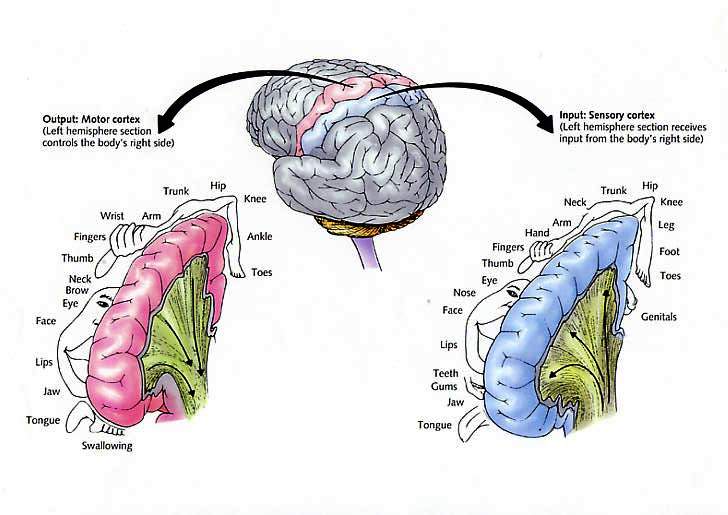
      • Contralateral control: right controls left and vice versa.
      • Left Hemisphere: logic and sequential tasks.
      • Right Hemisphere: spatial and creative tasks.
    • Frontal Lobes: abstract thought and emotional control.
      • Motor Cortex: sends signals to our body controlling muscle movements.
      • Broca's Area: responsible for controlling muscles that produce speech.
      • Broca's Aphasia: damage to Broca's Area. Unable to make movements to talk.
    • Parietal Lobes: contain Sensory Cortex:
      • Sensory Cortex: receives incoming touch sensations from rest of the body. Most of the Parietal Lobes are made up of Association Areas.
    • Association Areas: any areas not associated with reviving sensory information or coordinating muscle movements.
    • Occipital Lobes: deals with vision. Contains Visual Cortex: interprets messages from our eyes into images we can understand.
    • Temporal Lobes: process sound sensed by our ears. Contains Wernike's Area: interprets written and spoken speech. Wernike's Aphasia: unable to understand language: the syntax and grammar jumbled.
    • Brain Plasticity: the idea that the brain, when damaged, will attempt to find new ways to reroute messages.
    • The Corpus Callosum: bridge of nerve fibers that connects or divides the two hemisphere.
    • Cerebrum: largest part of the brain. Divided into left and right hemisphere & divided into lobes. Also contains the cerebral cortex (the gray matter). Controls voluntary movement, coordinates mental activity, and it's the center for all conscious living.

Nervous System


  • Central Nervous System: the brain and spinal card.
  • Peripheral Nervous System: all nerves that are not encased in bone. Everything but the brain and spinal cord.
    • Somatic: controls voluntary muscle movement. Uses motor neurons.
    • Autonomic: controls the automatic functions of the body.
      • Sympathetic: fight or flight response. Automatically accelerates heart rate, breathing, dilates pupils, slows down digestion.
      • Parasympathetic: automatically slows the body down after a stressful event. Heart rate and breathing slow down pupils constrict and digestion speeds up.
  • Reflexes: normally, sensory neurons take info up through spine to the brain. Some reactions occur when sensory neurons reach just the spinal cord.
  • Hormones
    • The Endocrine System: a system of glands that secrete hormones.  Similar to nervous system, except hormones work a lot slower than neurotransmitters.

Monday, April 6, 2015

Unit 4

  • Nervous System: it starts with an individual nerve cell called a NEURON
    • How does a Neuron fire?
      • Resting potential: slightly negative charge
      • Reach the threshold when enough neurotransmitters reach dendrites.
      • Go into Action Potential (firing)
    • The All-or-None Response: the idea that either the neuron fires or it does not-no part way firing. Like a gun.
  • Steps of Action Potential
    • Dendrites receive neurotransmitter from another neuron across the synapse.
    • Reached its threshold- then fires based on the all-or-none response.
    • Opens up a portal in axon, and lets in positive ions (Sodium) which mix with negative ions (Potassium) that is already inside the axon (thus Neurons at rest have a slightly negative charge).
    • The mixing of + and - ions causes an electrical charge that opens up the next portal (letting in more K) while closing the original portal.
    • Process continues down axon to the axon terminal.
    • Terminal buttons turns electrical charge into chemical (neurotransmitter) and shoots message to next neuron across the synapse.
  • Types of Neurotransmitter
    • Acetylcholine (ACH): deals with motor movement and memory. Lack of ACH has been linked to Alzheimer's disease.
    • Dopamine: deals with motor movements and alertness. Lack of dopamine has been linked to Parkinson's disease. Too much has been linked to schizophrenia.
    • Serotonin: involved in mood control. Lack of serotonin has been linked to clinical depression.
    • Endorphins: involve in pain control. Many of our most addictive drugs deal with endorphins.
    • Norepinephrine: helps control alertness and arousal. An undersupply can lead to depression. An oversupply can lead to manic symptoms
    • GABA (gamma-aminobutytic acid): major inhibitory neurotransmitters. An undersupply can lead to tremor.
    • Glutamate: major excitatory neurotransmitter; involved in memory. Oversupply can overstimulate the brain leading to migraines (this is why some people avoid MSG in food).
  • Drugs can be...
    • Agonist- make neuron fire
    • Antagonists- stop neural firing
    • Reuptake Inhibitors- block neurotransmitters from entering the neuron.
  • Types of Neurons
    • Sensory Neurons (Afferent Neurons): take information from the senses to the brain.
    • Inter Neurons: take messages from Sensory Neurons to other parts of the brain or to Motor Neurons.
    • Motor Neurons (Efferent Neurons): take information from the brain to the rest of the body.