The Brain
- Accidents: Phineas Gage Story-Personality changed after the accident.
- Lesions: removal or destruction of some part of the brain. Frontal Lobotomy
- Electroencephalogram (EEG): detects brain waves through their electrical output. Used mainly in sleep research.
- Computerized Axial Tomography (CAT Scan): 3D X-Ray of the brain. good for tumor locating but tells us nothing about function.
- Magnetic Resonance Imaging (MRI): more detailed picture of brain using magnetic field to knock electrons off axis.
- Positron Emission Tomography (PET Scan): measures how much of a chemical the brain is using (usually glucose consumption).
Brain Structure
- Hindbrain: structures on top of our spinal cord. Controls basic biological structures.
- Pons: located just above the medulla.
- Cerebellum: bottom rear of the brain. "Little brain." coordinates fine muscle movements.
- Midbrain: coordinates simple movement with sensory information. Most important structure in Midbrain is the Reticular Formation: controls arousal and ability to focus our attention.
- Forebrain: what makes us human. Largest part of the brain. Made up of the Thalamus, Limbic System, and Cerebral Cortex.
- Thalamus: receives sensory signals from the spinal cord and sends them to other parts of the forebrain. Every sense except smell.
- Limbic System
- Hypothalamus: maybe most important structure in the brain. Controls and regulates: body temperature, sexual arousal, hunger, thirst, and endocrine system.
- Hippocampus: involved in the processing and storage of memories.
- Amygdala: involved in how we process memory. More involved in volatile emotions like anger.
- Cerebral Cortex: made up of densely packed neurons we call "gray matter." Glial Cells: support brain cells. Wrinkles are called fissures.
- Hemispheres: divided into two hemisphere.
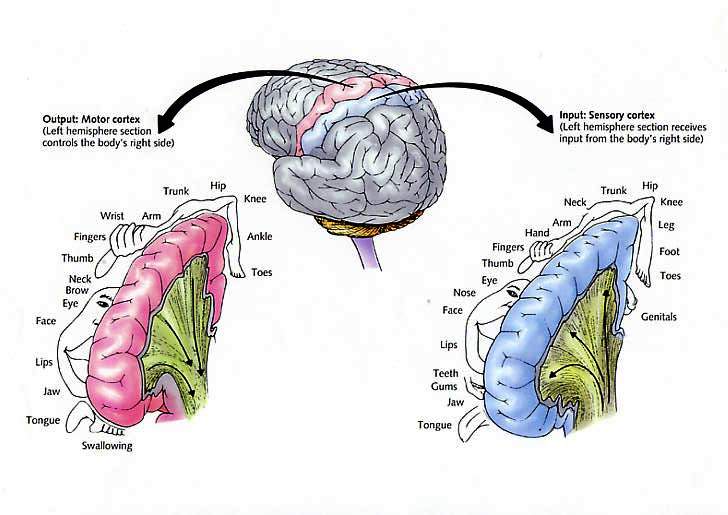
- Contralateral control: right controls left and vice versa.
- Left Hemisphere: logic and sequential tasks.
- Right Hemisphere: spatial and creative tasks.
- Frontal Lobes: abstract thought and emotional control.
- Motor Cortex: sends signals to our body controlling muscle movements.
- Broca's Area: responsible for controlling muscles that produce speech.
- Broca's Aphasia: damage to Broca's Area. Unable to make movements to talk.
- Parietal Lobes: contain Sensory Cortex:
- Sensory Cortex: receives incoming touch sensations from rest of the body. Most of the Parietal Lobes are made up of Association Areas.
- Association Areas: any areas not associated with reviving sensory information or coordinating muscle movements.
- Occipital Lobes: deals with vision. Contains Visual Cortex: interprets messages from our eyes into images we can understand.
- Temporal Lobes: process sound sensed by our ears. Contains Wernike's Area: interprets written and spoken speech. Wernike's Aphasia: unable to understand language: the syntax and grammar jumbled.
- Brain Plasticity: the idea that the brain, when damaged, will attempt to find new ways to reroute messages.
- The Corpus Callosum: bridge of nerve fibers that connects or divides the two hemisphere.
- Cerebrum: largest part of the brain. Divided into left and right hemisphere & divided into lobes. Also contains the cerebral cortex (the gray matter). Controls voluntary movement, coordinates mental activity, and it's the center for all conscious living.



Friends of Gage, whom is mentioned above, claimed that the once kind and hard working Gage had changed after his accident to a lazy and rude man until he died years later. However unfortunate , this incident did allow doctors and psychologists to analyze the brain and see the importance and functions of the frontal lobe.
ReplyDeleteFriends of Gage, whom is mentioned above, claimed that the once kind and hard working Gage had changed after his accident to a lazy and rude man until he died years later. However unfortunate , this incident did allow doctors and psychologists to analyze the brain and see the importance and functions of the frontal lobe.
ReplyDelete